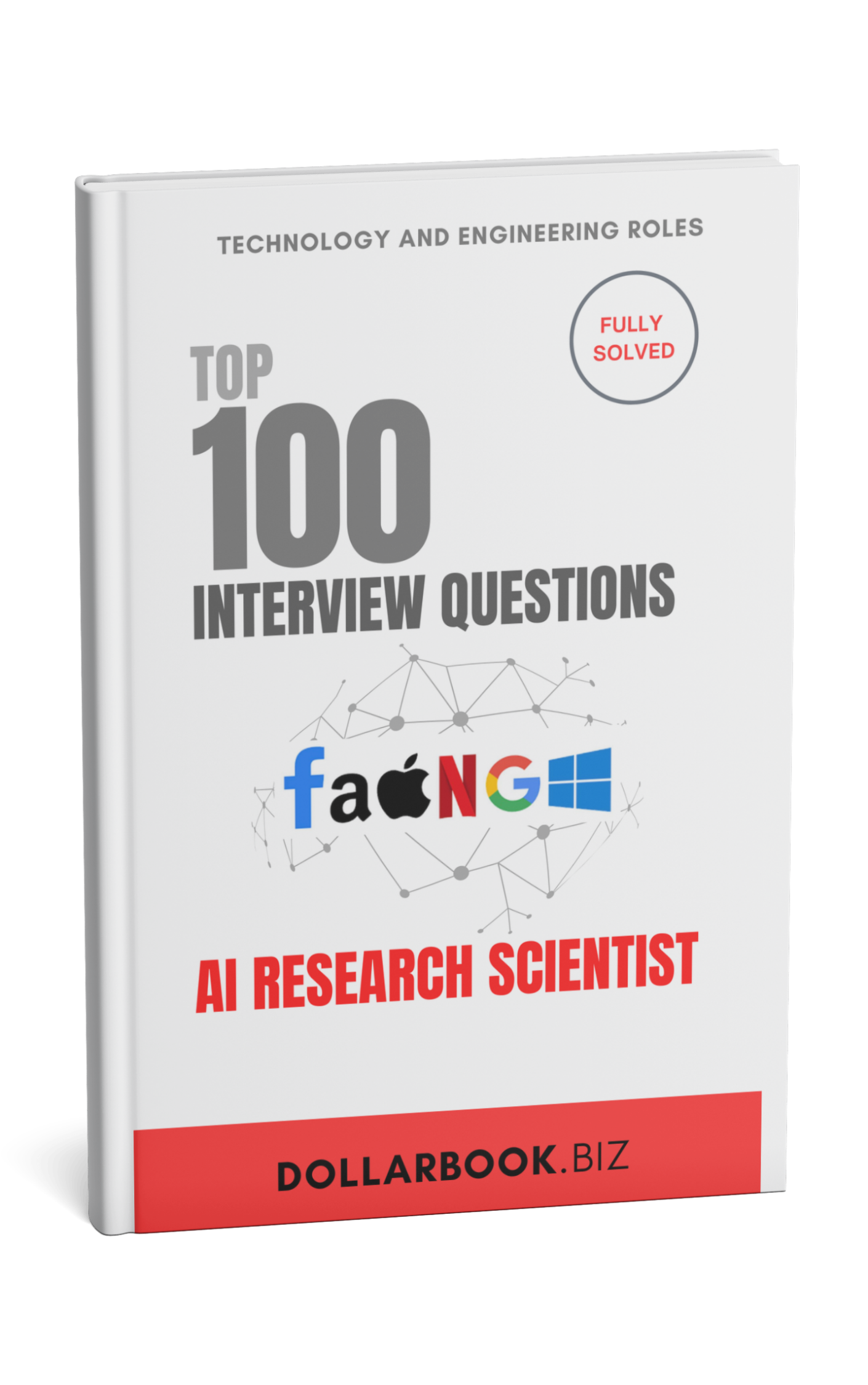
AI Research Scientist interview prep
Top 100 interview questions for AI Research Scientist — modeled on real FAANG loops.
Questions
100
Topics
10
Free to read now
10
Explain the bias-variance tradeoff.
The bias-variance tradeoff is a fundamental concept in machine learning that describes the balance between two types of errors that affect the performance of predictive models. Bias refers to the error due to overly simplistic assumptions in the learning algorithm, while variance refers to the error due to excessive sensitivity to fluctuations in the training data. Understanding and managing this tradeoff is crucial for building models that generalize well to new, unseen data.
Key Talking Points:
- Bias: Error from erroneous assumptions in the learning algorithm.
- Variance: Error from sensitivity to small fluctuations in the training set.
- Tradeoff: Increasing model complexity generally decreases bias but increases variance, and vice versa.
- Objective: Achieve a balance that minimizes total error (sum of bias and variance).
NOTES:
Reference Table:
| Aspect | High Bias | High Variance |
|---|---|---|
| Model Type | Simple (e.g., linear models) | Complex (e.g., deep neural nets) |
| Error | High training and test error | Low training error, high test error |
| Generalization | Poor | Poor |
| Cause of Error | Underfitting | Overfitting |
Follow-Up Questions and Answers:
-
What strategies can be used to manage the bias-variance tradeoff?
- Answer: Strategies include using techniques like cross-validation to evaluate model performance, regularization methods to penalize complexity, and ensemble methods like bagging and boosting to reduce variance.
-
How does the bias-variance tradeoff impact model selection?
- Answer: The tradeoff influences the choice of model complexity during the model selection process. Simpler models are chosen to reduce variance, while more complex models are selected to reduce bias.
-
What is the relationship between bias-variance tradeoff and overfitting/underfitting?
- Answer: Overfitting is closely related to high variance, where the model learns noise in the training data. Underfitting is related to high bias, where the model is too simplistic to capture the underlying pattern in the data.
Machine Learning Fundamentals
10 questionsDeep Learning
10 questionsNatural Language Processing (NLP)
10 questionsData Science and Statistics
10 questionsAlgorithms and Data Structures
10 questionsSoftware Engineering Practices
10 questionsEthics and Bias in AI
10 questionsAdvanced Topics
10 questionsInterview and Problem-Solving Skills
10 questionsCompany-Specific and Behavioral Questions
10 questionsWhat is in this role
| Topic | Questions | Free | Median length | Difficulty |
|---|---|---|---|---|
| Machine Learning Fundamentals | 10 | 10 | 710 words | medium |
| Deep Learning | 10 | 0 | 671 words | medium |
| Natural Language Processing (NLP) | 10 | 0 | 661 words | medium |
| Data Science and Statistics | 10 | 0 | 572 words | medium |
| Algorithms and Data Structures | 10 | 0 | 690 words | medium |
| Software Engineering Practices | 10 | 0 | 621 words | medium |
| Ethics and Bias in AI | 10 | 0 | 568 words | medium |
| Advanced Topics | 10 | 0 | 672 words | medium |
| Interview and Problem-Solving Skills | 10 | 0 | 612 words | medium |
| Company-Specific and Behavioral Questions | 10 | 0 | 635 words | medium |
What you get for your money
- ✓Every answer in one role, question by question.
- ✓The key points each answer is built from.
- ✓New questions added to that role, free.
90 answers, behind this unlock
Machine Learning Fundamentals · Deep Learning · Natural Language Processing (NLP) · Data Science and Statistics · Algorithms and Data Structures · Software Engineering Practices · Ethics and Bias in AI · Advanced Topics · Interview and Problem-Solving Skills · Company-Specific and Behavioral Questions
one-time · yours permanently
- The 10 preview questions and their full model answers.
- Your account, notes, highlights, streak and read progress.
- 3 AI grades a day.
- The daily challenge.