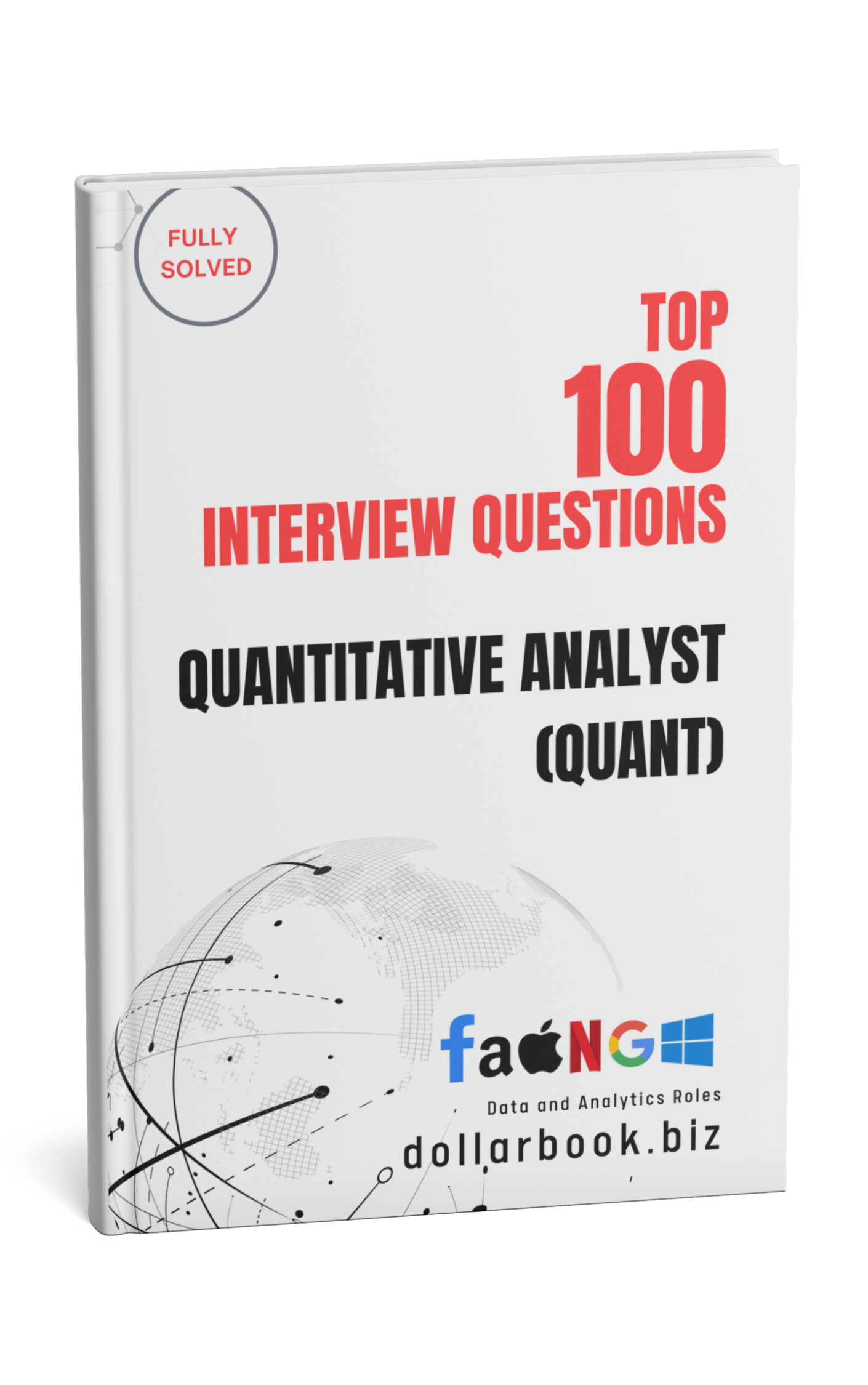
Quantitative Analyst (Quant) interview prep
Top 100 interview questions for Quantitative Analyst (Quant) — modeled on real FAANG loops.
Questions
100
Topics
10
Free to read now
10
What is the difference between a permutation and a combination?
When preparing for a Quantitative Analyst interview at a FAANG company, it's important to understand the difference between permutations and combinations, as they are fundamental concepts in probability and statistics.
Explanation:
- A permutation is an arrangement of items in a specific order. Order matters in permutations.
- A combination is a selection of items without considering the order. Order does not matter in combinations.
Key Talking Points:
- Permutations:
- Order matters.
- Used when arranging items.
- Example: Arranging books on a shelf.
- Combinations:
- Order does not matter.
- Used when selecting items.
- Example: Choosing team members from a group.
NOTES:
Reference Table:
| Feature | Permutation | Combination |
|---|---|---|
| Definition | Arrangement of items in order | Selection of items without order |
| Order | Important | Not important |
| Formula | ( nPr = \frac{n!}{(n-r)!} ) | ( nCr = \frac{n!}{r!(n-r)!} ) |
| Example | Arranging books on a shelf | Selecting team members from a group |
Pseudocode:
   from math import factorial

   def permutations(n, r):
       return factorial(n) // factorial(n - r)

   def combinations(n, r):
       return factorial(n) // (factorial(r) * factorial(n - r))

   # Example usage:
   n = 5
   r = 3
   print("Permutations:", permutations(n, r))  # Output: 60
   print("Combinations:", combinations(n, r))  # Output: 10
Follow-Up Questions and Answers:
-
Question: How would you calculate permutations and combinations for larger numbers efficiently?
- Answer: For larger numbers, using libraries or functions that handle big integers is crucial. Python's
mathlibrary is efficient for factorial calculations, but if performance is a concern, consider using memoization or dynamic programming to store intermediate results and avoid redundant calculations.
- Answer: For larger numbers, using libraries or functions that handle big integers is crucial. Python's
-
Question: Can you explain how permutations and combinations apply to probability?
- Answer: In probability, permutations can be used to calculate the likelihood of events where order matters, such as ranking outcomes in a race. Combinations are used when calculating probabilities for events where order does not matter, such as drawing cards from a deck.
-
Question: How do permutations and combinations differ in terms of computational complexity?
- Answer: Both permutations and combinations involve factorial calculations, which can become computationally intensive as numbers grow larger. However, combinations are generally less computationally expensive since they involve fewer total calculations due to the division by additional factorials.
-
Question: How can understanding these concepts help in a real-world quant role?
- Answer: Understanding permutations and combinations helps in risk assessment, portfolio optimization, and scenario analysis, where the arrangement or selection of assets needs to be evaluated under different conditions.
Probability and Statistics
10 questionsMathematics and Calculus
10 questionsData Analysis and Interpretation
10 questionsFinancial Markets and Instruments
10 questionsMachine Learning and Algorithms
10 questionsProgramming and Coding
10 questionsEconomics and Econometrics
10 questionsProblem-Solving and Critical Thinking
10 questionsIndustry Knowledge and Trends
10 questionsCommunication and Collaboration
10 questionsWhat is in this role
| Topic | Questions | Free | Median length | Difficulty |
|---|---|---|---|---|
| Probability and Statistics | 10 | 10 | 652 words | medium |
| Mathematics and Calculus | 10 | 0 | 657 words | medium |
| Data Analysis and Interpretation | 10 | 0 | 685 words | medium |
| Financial Markets and Instruments | 10 | 0 | 601 words | medium |
| Machine Learning and Algorithms | 10 | 0 | 628 words | medium |
| Programming and Coding | 10 | 0 | 597 words | medium |
| Economics and Econometrics | 10 | 0 | 618 words | medium |
| Problem-Solving and Critical Thinking | 10 | 0 | 606 words | medium |
| Industry Knowledge and Trends | 10 | 0 | 576 words | medium |
| Communication and Collaboration | 10 | 0 | 614 words | medium |
What you get for your money
- ✓Every answer in one role, question by question.
- ✓The key points each answer is built from.
- ✓New questions added to that role, free.
90 answers, behind this unlock
Probability and Statistics · Mathematics and Calculus · Data Analysis and Interpretation · Financial Markets and Instruments · Machine Learning and Algorithms · Programming and Coding · Economics and Econometrics · Problem-Solving and Critical Thinking · Industry Knowledge and Trends · Communication and Collaboration
one-time · yours permanently
- The 10 preview questions and their full model answers.
- Your account, notes, highlights, streak and read progress.
- 3 AI grades a day.
- The daily challenge.