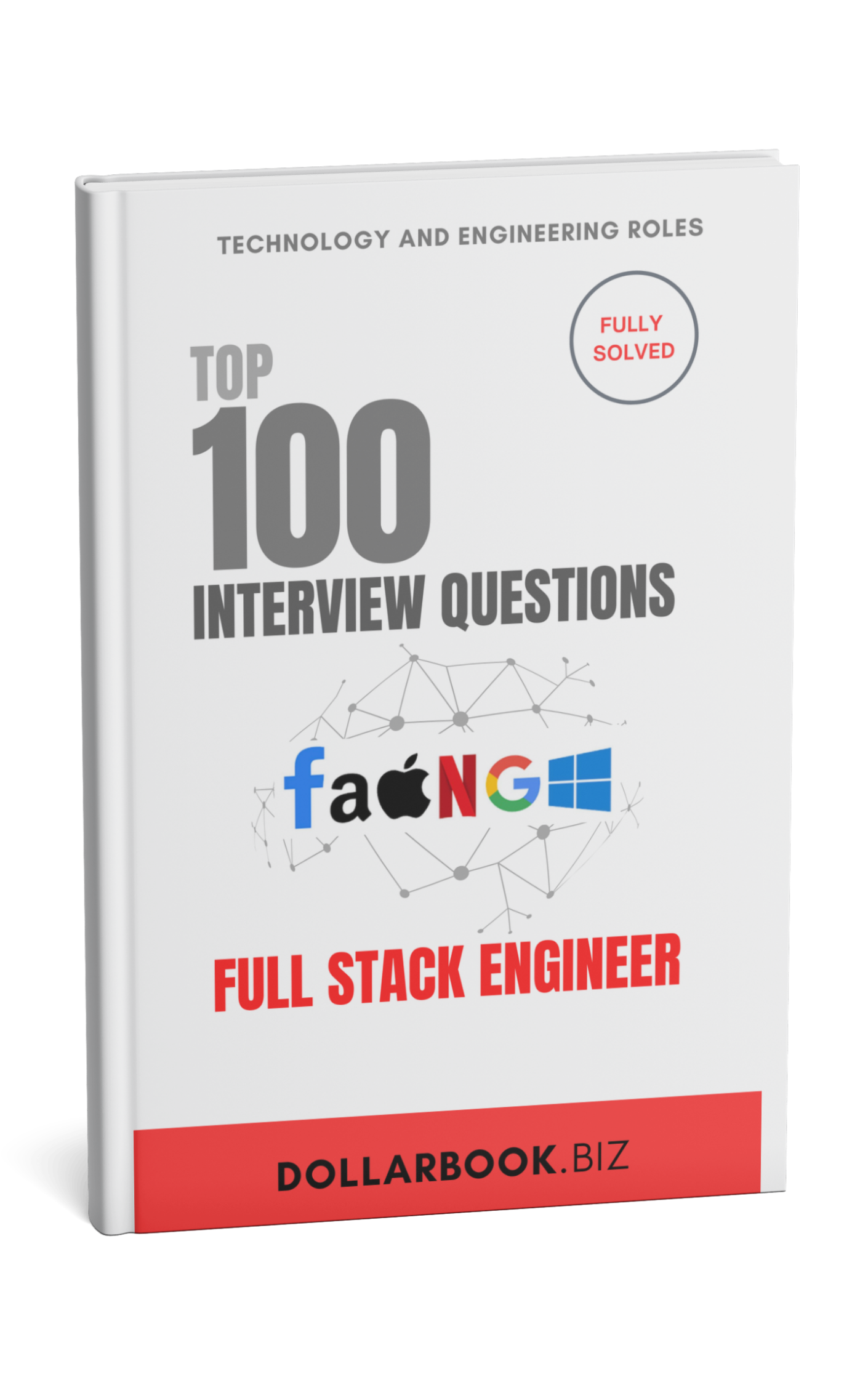
Full Stack Engineer interview prep
Top 100 interview questions for Full Stack Engineer — modeled on real FAANG loops.
Questions
100
Topics
14
Free to read now
10
Explain the concept of object-oriented programming and its four main principles.
Object-oriented programming (OOP) is a programming paradigm that organizes software design around data, or objects, rather than functions and logic. An object can be defined as a data field that has unique attributes and behavior.
OOP is based on four main principles:
-
Encapsulation: This principle states that all data and operations on the data are bundled together, restricting access to some components. This is akin to a capsule where the internal details are hidden, exposing only necessary parts.
-
Abstraction: This involves hiding the complex implementation details and showing only the essential features of the object. It simplifies interaction with the object without knowing the intricacies of its implementation.
-
Inheritance: This allows a new class, called a subclass, to inherit properties and behavior from an existing class, known as a superclass. It promotes code reusability and establishes a hierarchical relationship between classes.
-
Polymorphism: This principle allows objects to be treated as instances of their parent class. The same interface or operation can behave differently on different classes or objects. It is mainly achieved through method overriding and method overloading.
Key Talking Points:
- Encapsulation: Bundles data and methods, restricting access to certain components.
- Abstraction: Hides complex details; exposes only needed features.
- Inheritance: Promotes code reuse by allowing new classes to inherit properties from existing ones.
- Polymorphism: Allows one interface to be used for different data types.
Follow-Up Questions and Answers:
-
What are some advantages of using OOP?
- Modularity: OOP code is modular, which makes it easier to maintain and modify.
- Reusability: Through inheritance, you can reuse existing code.
- Scalability: OOP systems can be scaled easily to include more objects.
- Maintainability: Easier to debug and maintain due to encapsulation.
-
Can you give an example of polymorphism in a programming language like Java?
   class Animal {
       public void sound() {
           System.out.println("Animal makes a sound");
       }
   }

   class Dog extends Animal {
       public void sound() {
           System.out.println("Bark");
       }
   }

   class Cat extends Animal {
       public void sound() {
           System.out.println("Meow");
       }
   }

   public class TestPolymorphism {
       public static void main(String[] args) {
           Animal myAnimal = new Animal();
           Animal myDog = new Dog();
           Animal myCat = new Cat();

           myAnimal.sound();
           myDog.sound();
           myCat.sound();
       }
   }
-
How is OOP different from procedural programming?
Feature OOP Procedural Programming Approach Object-oriented Function-oriented Code Organization Objects and classes Functions and modules Data Handling Encapsulated in objects Global data accessible by functions Reusability High (inheritance, polymorphism) Limited Complexity Handling Better suited for complex systems Better for simple tasks
General Programming Concepts
7 questionsData Structures and Algorithms
8 questionsFront-End Development
8 questionsBack-End Development
8 questionsDatabases
7 questionsDevOps and Deployment
7 questionsSecurity
7 questionsTesting
6 questionsSystem Design
7 questionsProblem Solving and Coding Challenges
8 questionsBehavioral Questions
7 questionsMiscellaneous
7 questionsAdvanced Topics
7 questionsEmerging Trends and Technologies
6 questionsWhat is in this role
| Topic | Questions | Free | Median length | Difficulty |
|---|---|---|---|---|
| General Programming Concepts | 7 | 7 | 634 words | medium |
| Data Structures and Algorithms | 8 | 3 | 662 words | medium |
| Front-End Development | 8 | 0 | 635 words | medium |
| Back-End Development | 8 | 0 | 642 words | medium |
| Databases | 7 | 0 | 591 words | medium |
| DevOps and Deployment | 7 | 0 | 623 words | medium |
| Security | 7 | 0 | 656 words | medium |
| Testing | 6 | 0 | 579 words | medium |
| System Design | 7 | 0 | 674 words | hard |
| Problem Solving and Coding Challenges | 8 | 0 | 596 words | medium |
| Behavioral Questions | 7 | 0 | 579 words | medium |
| Miscellaneous | 7 | 0 | 565 words | medium |
| Advanced Topics | 7 | 0 | 555 words | medium |
| Emerging Trends and Technologies | 6 | 0 | 670 words | medium |
What you get for your money
- ✓Every answer in one role, question by question.
- ✓The key points each answer is built from.
- ✓New questions added to that role, free.
90 answers, behind this unlock
General Programming Concepts · Data Structures and Algorithms · Front-End Development · Back-End Development · Databases · DevOps and Deployment · Security · Testing · System Design · Problem Solving and Coding Challenges · Behavioral Questions · Miscellaneous · Advanced Topics · Emerging Trends and Technologies
one-time · yours permanently
- The 10 preview questions and their full model answers.
- Your account, notes, highlights, streak and read progress.
- 3 AI grades a day.
- The daily challenge.
Related roles
All of them sit on the Software engineering path — $14.99 for all 4.