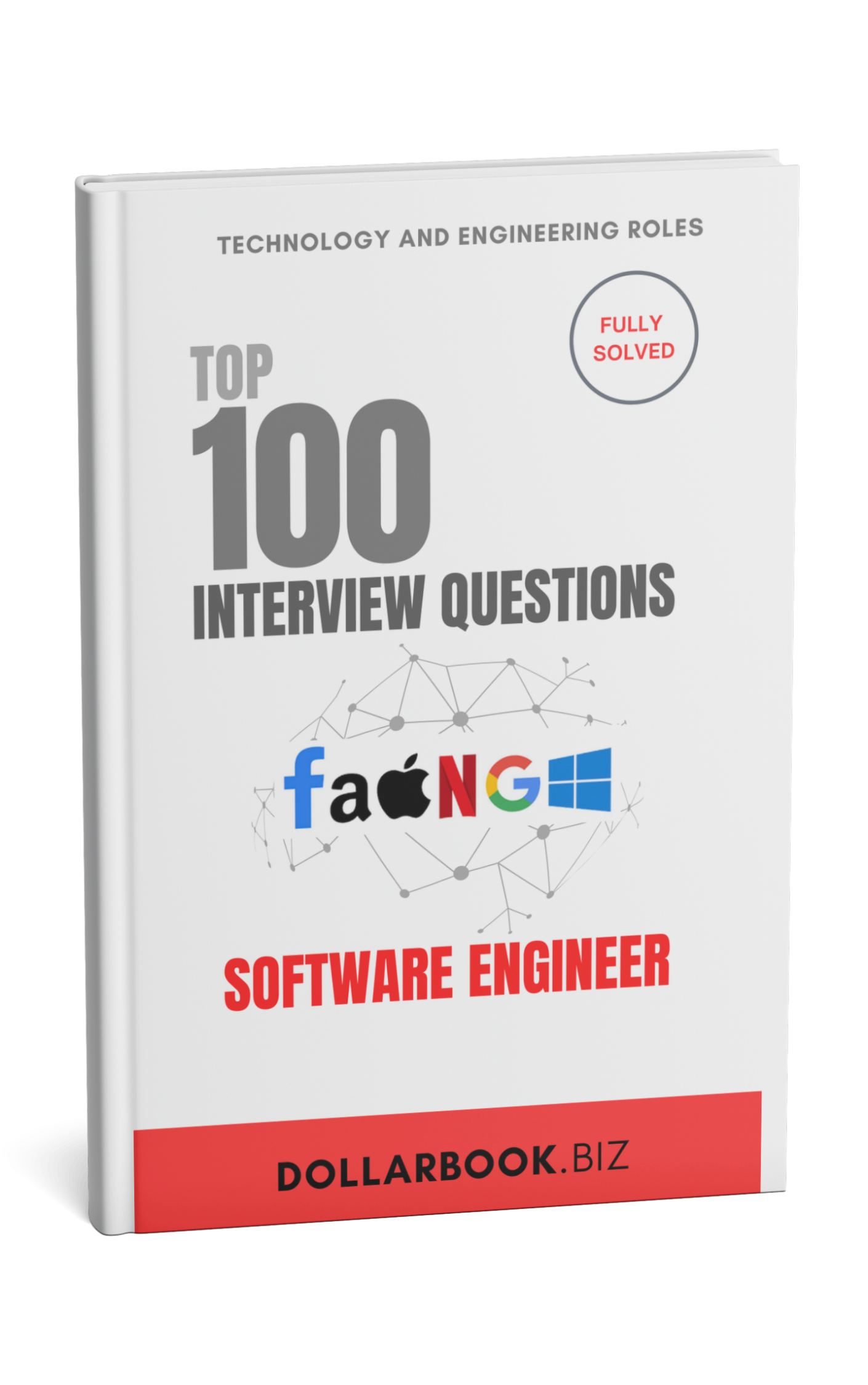
Software Engineer interview prep
Top 100 interview questions for Software Engineer — modeled on real FAANG loops.
Questions
100
Topics
9
Free to read now
10
Describe the difference between an array and a linked list.
When comparing arrays and linked lists, it's important to understand that they are both fundamental data structures used to store collections of elements, but they have different characteristics and use cases.
-
Array: An array is a collection of elements identified by index or key. The elements are stored in contiguous memory locations. Arrays allow quick access to elements using indices, which provides constant time complexity, O(1), for accessing elements. However, resizing an array is costly, as it involves creating a new array and copying elements over.
-
Linked List: A linked list is a collection of nodes where each node contains a data element and a reference (or a pointer) to the next node in the sequence. This structure allows for dynamic resizing and efficient insertion or deletion of elements, as these operations do not require shifting elements. However, accessing an element in a linked list requires traversing from the head node to the desired position, resulting in a linear time complexity, O(n).
Key Talking Points:
- Access Time:
- Array: O(1)
- Linked List: O(n)
- Memory Usage:
- Array: Contiguous memory allocation
- Linked List: Non-contiguous memory allocation
- Insertion/Deletion:
- Array: Costly, O(n)
- Linked List: Efficient, O(1) if at head or O(n) if at specific position
- Resizing:
- Array: Requires creating a new larger array
- Linked List: Dynamic resizing
NOTES:
Reference Table:
| Feature | Array | Linked List |
|---|---|---|
| Memory Allocation | Contiguous | Non-contiguous |
| Access Time | O(1) | O(n) |
| Insertion/Deletion | O(n) | O(1) at head, O(n) at specific position |
| Resizing | Requires new array | Dynamic |
| Memory Overhead | Less (no pointers) | More (pointers) |
A linked list, on the other hand, is like a treasure map where each clue (node) leads you to the next one. You can easily add or remove clues, but finding a specific item means following the map from the beginning until you reach it.
Follow-Up Questions and Answers:
-
Question: What are the different types of linked lists?
- Answer: Linked lists can be categorized into several types, including singly linked lists, doubly linked lists, and circular linked lists. A singly linked list allows traversal in one direction, while a doubly linked list allows traversal in both directions as each node contains pointers to both the next and previous nodes. A circular linked list is a variation where the last node points back to the first node, creating a circular structure.
-
Question: How would you choose between using an array and a linked list?
- Answer: The choice depends on the specific requirements of the application. If you need fast random access to elements and know the size of the data set beforehand, an array is suitable. If the data size is dynamic or you require frequent insertions and deletions, a linked list would be more efficient.
-
Question: Can you implement a simple linked list in pseudocode?
- Answer:
     class Node:
         data
         next

     class LinkedList:
         head

         method insert(new_data):
             new_node = Node(new_data)
             new_node.next = head
             head = new_node

         method delete(key):
             temp = head
             if temp is not None and temp.data == key:
                 head = temp.next
                 temp = None
                 return

             while temp is not None:
                 if temp.data == key:
                     break
                 prev = temp
                 temp = temp.next

             if temp == None:
                 return

             prev.next = temp.next
             temp = None
These points and explanations should provide a solid foundation for discussing arrays and linked lists in a software engineering interview.
Algorithms and Data Structures
20 questionsSystem Design
10 questionsProgramming Concepts
10 questionsDatabases
10 questionsOperating Systems
10 questionsNetworking
10 questionsSecurity
10 questionsTesting and Debugging
10 questionsMiscellaneous
10 questionsWhat is in this role
| Topic | Questions | Free | Median length | Difficulty |
|---|---|---|---|---|
| Algorithms and Data Structures | 20 | 10 | 628 words | medium |
| System Design | 10 | 0 | 663 words | hard |
| Programming Concepts | 10 | 0 | 655 words | medium |
| Databases | 10 | 0 | 618 words | medium |
| Operating Systems | 10 | 0 | 580 words | medium |
| Networking | 10 | 0 | 635 words | medium |
| Security | 10 | 0 | 598 words | medium |
| Testing and Debugging | 10 | 0 | 621 words | medium |
| Miscellaneous | 10 | 0 | 657 words | medium |
What you get for your money
- ✓Every answer in one role, question by question.
- ✓The key points each answer is built from.
- ✓New questions added to that role, free.
90 answers, behind this unlock
Algorithms and Data Structures · System Design · Programming Concepts · Databases · Operating Systems · Networking · Security · Testing and Debugging · Miscellaneous
one-time · yours permanently
- The 10 preview questions and their full model answers.
- Your account, notes, highlights, streak and read progress.
- 3 AI grades a day.
- The daily challenge.
Related roles
All of them sit on the Software engineering path — $14.99 for all 4.